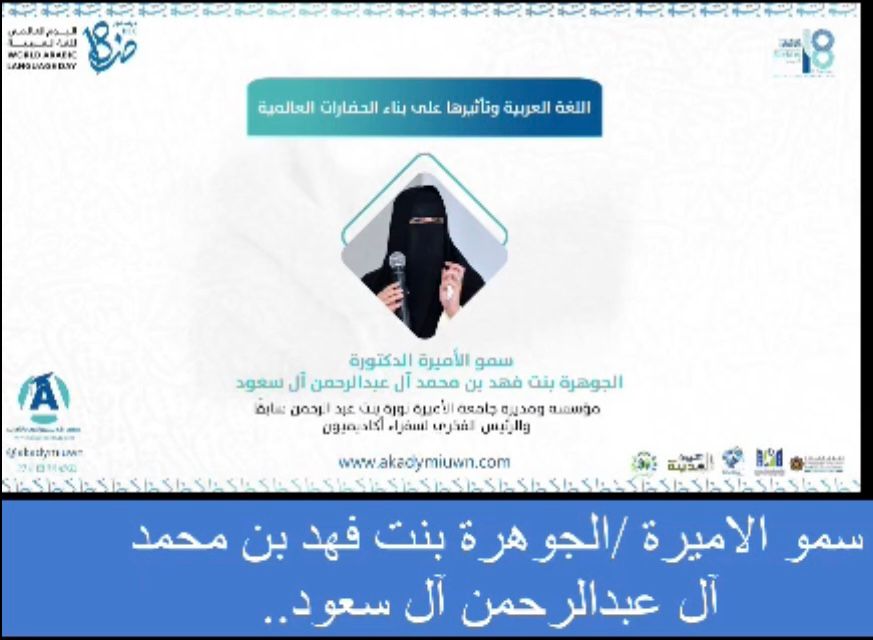
(The Arabic Language and Its Impact on Building Global Civilizations) Tuesday Evening for the ACADEMION Cultural Platform
The ACADEMION Cultural Platform, a non-profit organization dedicated to spreading knowledge and sciences through ambassadors, members, and advisors of the institute, organized an evening titled (The Arabic Language and Its Impact on Building Global Civilizations) on Tuesday, 22/6/1443 AH corresponding to 25/1/2022 AD, presented by Her Highness Princess Dr. Jawhara bint Fahd bin Mohammed Al Abdulrahman Al Saud, PhD in Arabic Language Sciences specializing in grammar and morphology, founder and director of Princess Nourah bint Abdulrahman University, assistant vice president for educational affairs, and dean of the College of Education for Girls in Riyadh, and a member of the International Federation of the Arabic Language. The evening began at 9 PM via Zoom, and was moderated by Dr. Basma Ahmed Jastania.
Her Highness spoke at the beginning of the evening about the Arabic language, noting that it is a common human trait shared by all people. The Arabic language is considered part of the Semitic language family, and there are four levels of interaction among people in the linguistic arena: sharing a dialect, sharing a language, sharing a mother tongue, and then sharing a language family. The ancient Arabic language branched into many dialects, each of which became a separate language before Islam, with two languages, 'Arabic and Hebrew', still surviving. Modern Arabic dialects are often incomprehensible to individuals within the Arab nation, and were it not for the existence of the Quran as a unifying element of great strength, each dialect would have developed into an independent language.
What are the characteristics of the language?
Her Highness pointed out that language has a human characteristic that connects it to humans rather than animals. Language is a living entity, and as the civilization of a nation expands, its language flourishes, its styles elevate, and new words are introduced to express new concepts and ideas, allowing the language to live and evolve over time, interacting with other languages. Any language in the world, while it influences others, is also influenced by them. The need of human beings for one another and the interdependence of humans make language essential for social communication.
The Arabic Language and Global Civilizations.
Her Highness emphasized that the Arabic language belongs to the group of Semitic languages, which also includes Canaanite, Phoenician, Hebrew, Aramaic, Nabataean, Babylonian, Syriac, and Amharic. Most of these languages have disappeared, leaving only traces and inscriptions on stones and skins.
She clarified that the Arabic language has lived a long period in human history as an official language encompassing all aspects of daily life, serving as the language of private life and public culture. Anyone claiming knowledge or thought had to master it. Arabic is a complete language that emerged fully developed outside the Arabian Peninsula, surpassing other languages because it is the language of the Quran. During the Abbasid era, the history of the Arabic language witnessed two significant developments: the documentation of sciences and the translation movement from the global heritage into Arabic.
Her Highness also mentioned that Europeans relied on Muslim writings in experimental sciences, translating them into Latin and then into modern European languages, forming a foundation for the European Renaissance. There is no doubt that this language, which has proven its vitality, is capable of keeping pace with all the scientific and cultural developments we see in our time and deserves our utmost attention and care.
The Experience of Islamic Civilization.
Her Highness addressed in the evening that there is no historical example of linguistic unification better than the experience of Islamic civilization with the Arabic language. Although Islam did not force anyone to adopt a specific belief or speak a particular language, and despite the fact that Islam encompassed most of the known languages and dialects in the world at that time, the acceptance of Islam was accompanied by a desire to learn the Arabic language, even among non-Muslims who adopted Arabic as their tongue. Additionally, the dominance of the Arabic language as the language of sciences further increased its appeal.
Her Highness explained that the acceptance of Islam and the eagerness to learn Arabic, as the language of sciences, later led to the spread of the Arabic language beyond the Arabian Peninsula and the Arab world to European countries. Today, the Arabic language represents a strong field of understanding and communication among the peoples who speak it, from the Atlantic Ocean to the Arabian Gulf, and literary and artistic production in classical Arabic is marketed in all these regions, unlike that produced in local dialects, even though it has a longer temporal existence.