
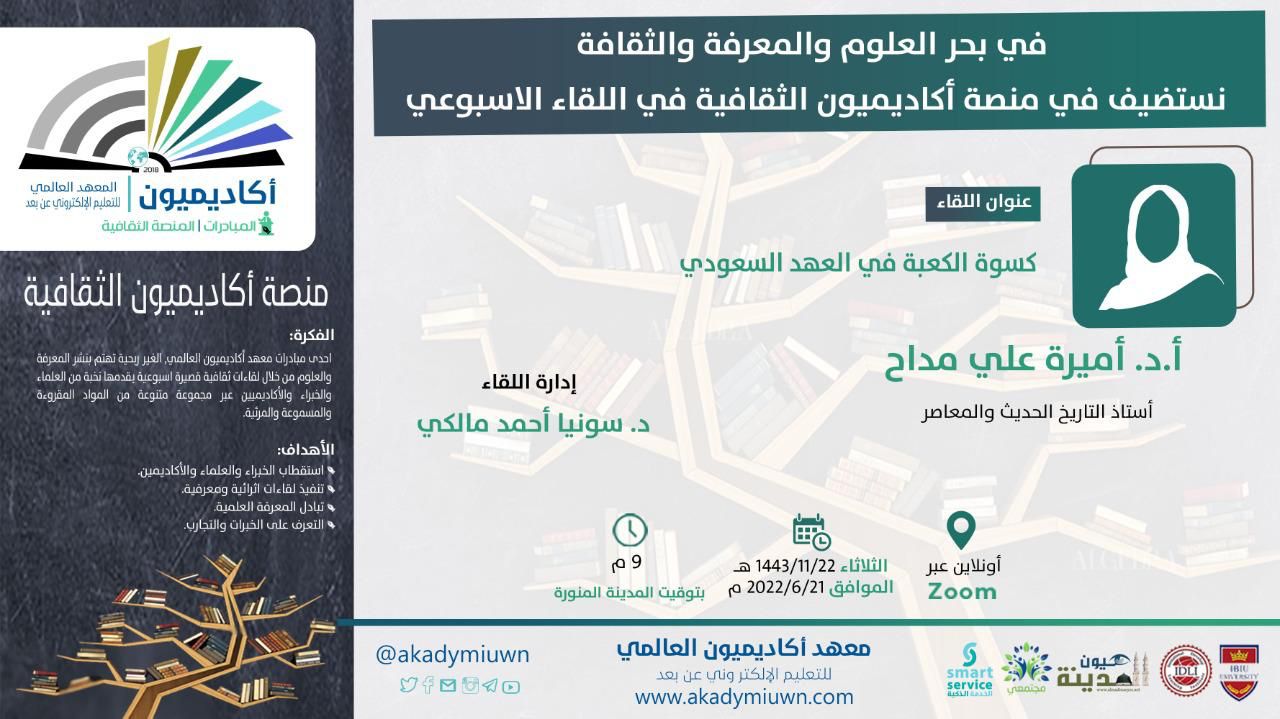
The ACADEMION Cultural Platform's meeting coinciding with the approaching Hajj season (The Kaaba's Covering in the Saudi Era)
Through the sea of knowledge and culture, the ACADEMION Cultural Platform, affiliated with the ACADEMION International Institute for Distance E-Learning, hosts the weekly meeting titled "The Covering of the Kaaba in the Saudi Era" on Tuesday, 1443/11/22 AH corresponding to 2022/6/21 AD. The meeting was presented by Dr. Amira bint Ali Madah, Professor of Modern and Contemporary History, and was conducted via Zoom and the ACADEMION channel on YouTube, with Dr. Sonia bint Ahmed Malaki managing the session.
Dr. Madah began the meeting by discussing the significance of the Holy Mosque and its remarkable architectural style, explaining its sanctity and religious status throughout time from before Islam until the present day. She also touched on the beginnings of the covering of the Holy Kaaba, noting that the first to cover the Kaaba was "As'ad al-Himyari," who saw in a dream that he was covering the Kaaba with "al-antaq" (a type of leather mat), so he did so. He then saw that he was covering it with "al-wasa'il" (a red striped garment made in Yemen), and then he covered it with "thiyab al-hubra" (a type of striped fabric made from wool from Yemen). He then covered it with "'asab" (a type of fabric that is difficult to weave) and made a door that could be closed.
Dr. Madah then mentioned that the first Arab woman to cover the Kaaba was "Natila bint Khabbab, the mother of Abbas ibn Abdul Muttalib," who covered it with silk and brocade. The covering during the pre-Islamic era was placed on the Kaaba in layers, and when it became heavy or worn out, it was removed.
Dr. Madah clarified that during the Islamic era, the Prophet Muhammad (peace be upon him) covered the Kaaba with Yemeni garments, and then Umar ibn al-Khattab covered it with "al-qabati" (a type of fabric made in Egypt attributed to the Copts of Egypt), and this was followed by Uthman ibn Affan (may Allah be pleased with them both).
Dr. Madah also mentioned the covering of the Holy Kaaba during the Umayyad era, where Muawiya ibn Abi Sufyan covered it twice a year, once with al-qabati and once with brocade. She also discussed the covering of the Kaaba during the Abbasid era, where they made luxurious coverings from black silk by the most skilled weavers, and both Al-Mahdi and Harun al-Rashid covered the Kaaba twice, while Al-Ma'mun covered it three times a year. She then summarized the covering of the Kaaba during the Mamluk era, which was covered by Al-Zahir Baybars.
Dr. Madah explained the covering of the Kaaba during the era of the First Saudi State, where Imam Saud the Great covered it with red silk, and then later with brocade and black qailan. She also discussed the covering of the Kaaba during the reign of the rulers of the Third Saudi State, where King Abdulaziz (may Allah have mercy on him) covered the Kaaba with padded qailan fabric on the 10th of Dhu al-Hijjah in the year 1344 AH / 1924 AD.
Dr. Madah also highlighted the Saudi state's efforts in establishing a factory for the covering of the Holy Kaaba, where Haj Muhammad Khan was appointed as its director. She then explained how the Kaaba was covered during the reign of King Faisal (may Allah have mercy on him), who ordered the establishment of a covering factory, and detailed the covering of the Kaaba during the reigns of King Khalid (may Allah have mercy on him), King Fahd (may Allah have mercy on him), King Abdullah (may Allah have mercy on him), and up to the reign of King Salman (may Allah protect him), and what has become of the covering of the Kaaba in our present time, where the Kaaba covering factory is named the King Abdulaziz Complex. She then referred to the ceremonies for delivering the covering of the Holy Kaaba and the connection of the Al-Sheibi family with the custodianship of the Holy Kaaba.
Dr. Madah then explained the ceremonies for washing the Holy Kaaba and dressing it in the new garment, and she also discussed the fate of the old covering of the Holy Kaaba when it is replaced with the new covering, as it is divided and distributed to the Al-Sheibi family, shared equally among them. All these efforts emphasize the attention and care of the Kingdom of Saudi Arabia and the efforts it exerts in the production of the covering of the Holy Kaaba, which is considered a source of pride in the flourishing Saudi era.