Symposium of ACADEMION Institute (Challenges of Education in the 21st Century)
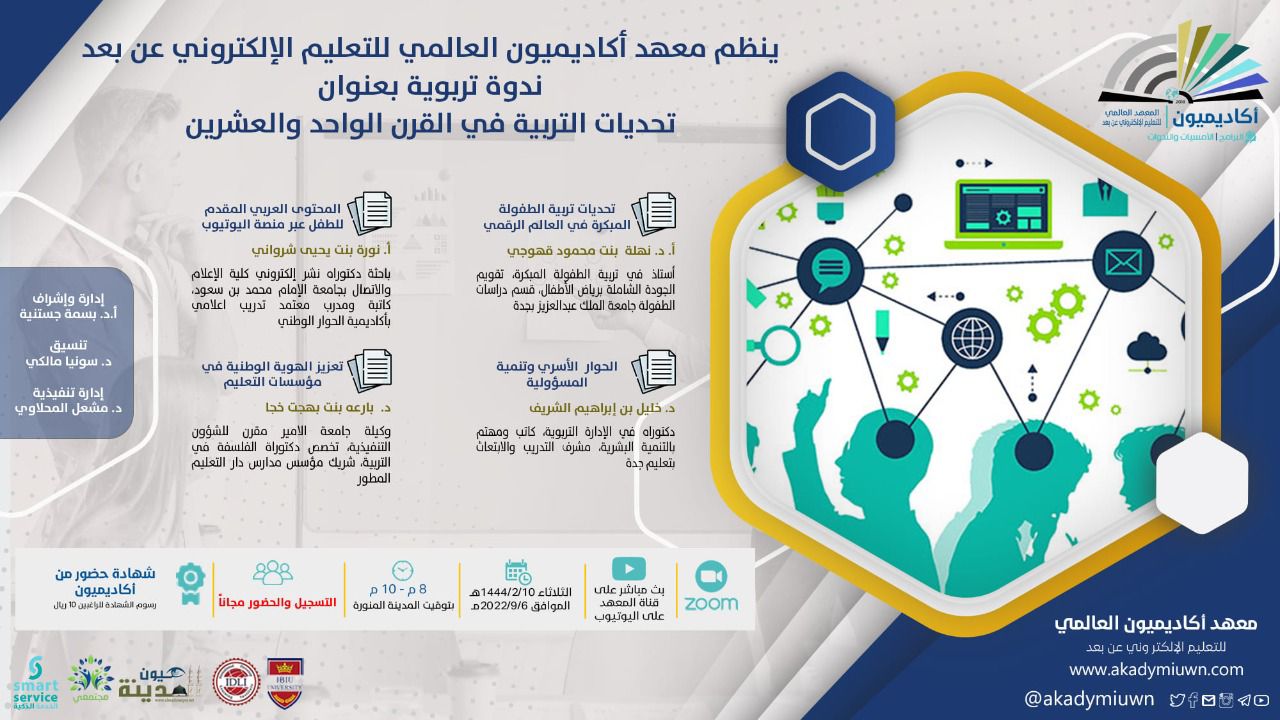
The ACADEMION Global Institute for Distance E-Learning organized an educational seminar titled: "Challenges of Education in the 21st Century" on Tuesday, September 6, 2022, corresponding to 10/2/1444 AH via Zoom. The seminar was moderated by His Excellency Dr. Mishal bin Yasin Al-Muhallawi, Deputy of ACADEMION Institute, and coordinated by Her Excellency Dr. Sonia Ahmed Malaki with executive management from His Excellency Dr. Mishal Al-Muhallawi.
The seminar began with His Excellency Dr. Mishal introducing that the children of this century face significant challenges, and preparing them to confront these challenges requires several things: a precise and conscious understanding of our reality, its potentials, problems, constraints, and starting points, as well as a scientific foresight of the future to understand its dimensions and life requirements, the magnitude and types of its challenges, and then striving in light of awareness of reality and a clear image of the future.
He also pointed out that the media has an effective role as a fundamental means of educating the nation and instilling awareness among youth about many truths. With the increase of satellite channels and modern technology, it can be a double-edged sword that can contribute to the growth and development of society and reinforce values or the opposite. He added, "Our children are the most susceptible group to be influenced by the values and customs adopted by the media. To advance education, immediate guidance is necessary to reach effective mechanisms based on in-depth scientific research and studies to address the problem of imported satellite channels."
He concluded his speech by stating that the preparation for the 21st century is not solely the responsibility of the government and the Ministry of Education; there is no success in education unless there is a family and home that support the children's orientations and instill in their minds and hearts the constants upon which national renaissance and development are based.
The seminar commenced with Her Excellency Professor Nahla Mahmoud Qahouji, a professor in Early Childhood Education and Comprehensive Quality Assessment in Kindergartens at King Abdulaziz University, presenting a paper titled (Challenges of Early Childhood Education in the Digital World), where she clarified the role of digital transformation in shaping childhood and changing children's interests and ways of receiving information. She noted that the opportunities for children to be exposed to inappropriate content, bullying, exploitation, and harassment have increased, in addition to the ease of accessing children's files and identities. She also emphasized that excessive internet use has significant negative effects on children, such as obesity, physical inactivity, headaches, eye strain, neck stiffness, and back pain, as well as its psychological and negative impact on the child, before outlining the positives of the internet for children.
She also addressed the armed terrorist organizations' establishment of networks for recruiting children and then provided solutions for dealing with the digital world, in addition to the role of teachers and parents in protecting children from the dangers of the digital world.
Her Excellency Professor Noura Yahya Sharwani, a PhD researcher in electronic publishing and a collaborative lecturer at the College of Media and Communication at Imam Muhammad bin Saud University, presented a paper titled (Arabic Content for Children on YouTube), discussing social media, its concept, and style, highlighting YouTube as a model. She reviewed what children do on YouTube and what YouTube does to them, the stance of parents and educators towards YouTube, and how to leverage YouTube.
She presented numerical facts about YouTube, then pointed out that thousands of young people have made YouTube a good source of income that is on the rise. With the increasing companies spending on advertising in the Arab world, profits are rising alongside the development of the quality of content provided to the audience.
His Excellency Dr. Khalil Ibrahim Al-Sharif, Supervisor of Teacher Affairs and Supervisor of Training and Scholarship at Jeddah Education, reviewed in his paper titled (Family Dialogue and Responsibility Development) the importance of family dialogue and forms of family dialogue, then clarified the development of responsibility among children. Dr. Al-Sharif explained the levels of family dialogue that begin with greetings, facts, feelings, then opinions and needs, and pointed out how family dialogue succeeds and when it fails.
The seminar concluded with Her Excellency Dr. Bariah Bahjat Khawja, Assistant Professor of Science Education at Prince Muqrin bin Abdulaziz University and Vice President for Executive Affairs, presenting a paper titled (Enhancing National Identity in Educational Institutions), where she discussed national identity, which carries the common characteristics distinguished by a group of people, usually derived from prevailing values, customs, and traditions. She clarified why national identity is a fundamental pillar from which a person derives their belonging to a state or nation.
She also explained the concepts related to national identity such as belonging and loyalty, presented the elements and components of identity, in addition to the challenges of enhancing national identity, and emphasized the role of institutions in enhancing national identity as well as the role of education in enhancing national identity through curricula, teachers, and student activities. She then added some recommendations and advice for the role of education in promoting the values of citizenship and national identity as a primary requirement and a fundamental goal of the strategic objectives of the Ministry of Education.