ACADEMION Cultural Platform discusses (the relationship between East and West)
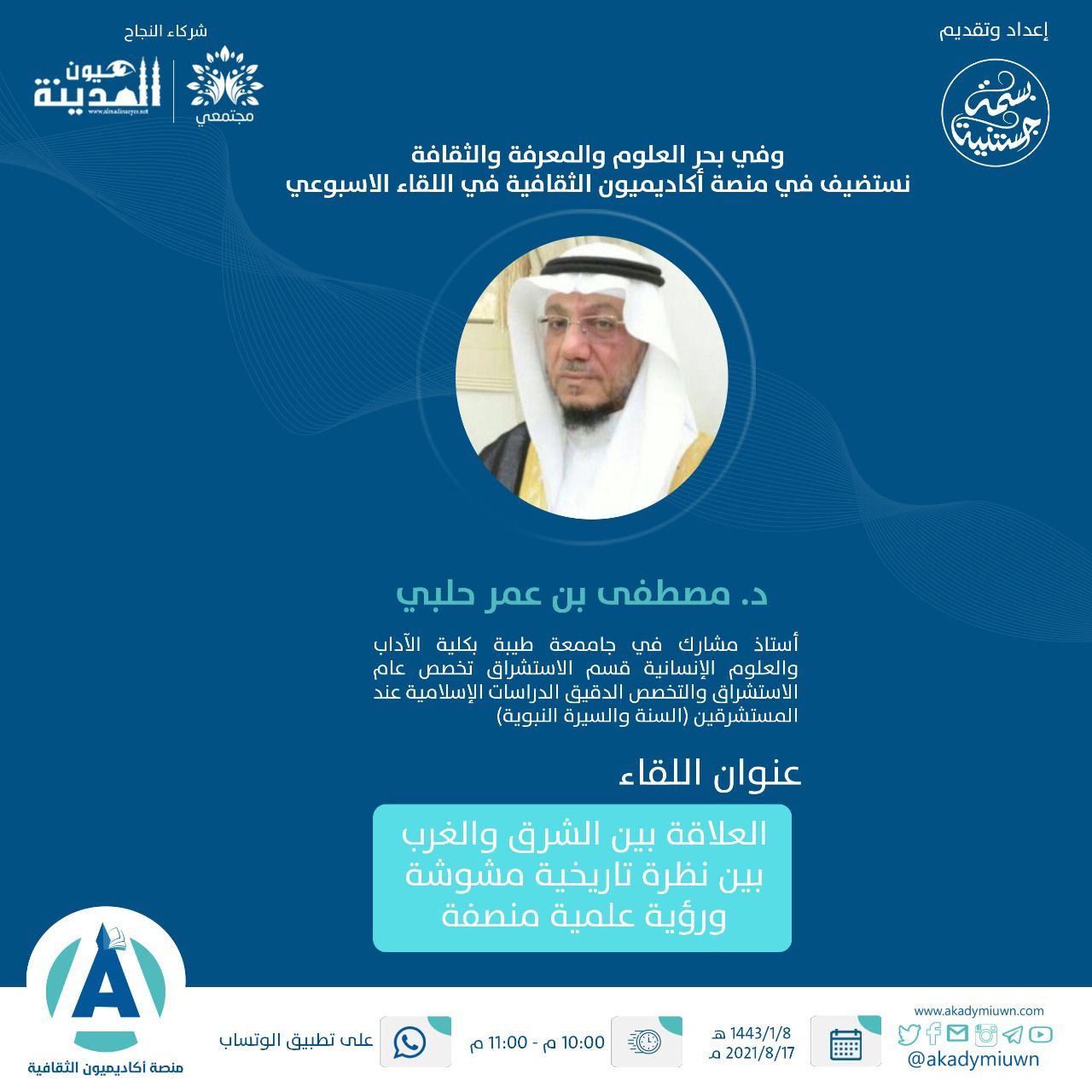
As part of the series of meetings presented by the ACADEMION Institute through the ACADEMION Cultural Platform, a non-profit platform that aims to disseminate knowledge and sciences through the ambassadors and advisors of the institute, and through a variety of reading, audio, and visual materials, the platform presented a cultural dialogue within a series of interactive dialogues that include a distinguished elite of intellectuals and pioneers of science in various fields. The meeting on Tuesday, corresponding to 8/1/1443 AH, hosted His Excellency Dr. Mustafa bin Omar Halabi, Associate Professor at Taibah University in the College of Arts and Humanities, Department of Oriental Studies, specializing in general Oriental studies and the specific specialization of Islamic studies among Orientalists (the Sunnah and the prophetic biography). The title of the meeting was "The relationship between East and West: between a confused historical perspective and a fair scientific vision" and the meeting began at ten o'clock in the evening, presented by Dr. Mishal Al-Mahlawi via the program ZOOM.
Dr. Halabi initially raised several questions about the historical relationship between the Eastern and Western worlds, the nature of the relationship historically, and the factors that negatively or positively affected this relationship, whether distantly or closely, between the two civilizations over a long historical span. He discussed the confused perspective and the vision that began to approach the scientific side and fairness in light of modern and contemporary civilizational changes.
Dr. Halabi added in his discussion about the relationship between East and West that it began very early and continues to this day, and it will remain so as it is a divine cosmic law. The relationship has been negatively and positively affected by multiple factors, where a specialized trend in studying the emergence and development of Western perceptions about Islam in the Middle Ages and modern times was formed in Western Islamic studies in the 1950s. For example, in popular awareness, in literature, in theology, and in Islamic studies, and from here emerged the specialties of Orientalists that began in modern times, which concerned the relationship between Islamic civilization and Western civilization in terms of points of convergence and divergence throughout the historical timeline in the 7th century AD. The studies that emerged recently attempted to modernize the nature of that perspective that influenced the formation of visions and imaginations, especially concerning the East, which is represented in Islamic civilization and the personality of the Prophet Muhammad (peace be upon him).
Dr. Halabi explained the essence of the relationship in Western awareness and in their feelings and subconscious, where they formed stereotypical mental images about Arabs or the East and Islam, which were a contradictory mix of objective knowledge and contained serious distortions of pure imagination, and that image dominated for a long time in the Western mentality about Arab Islamic civilization. This relationship began at the end of the first century AH and the 7th century AD, and this period is considered very early. Europe was astonished at the rapid spread of Islam and was surprised that Islamic civilization began to knock on its doors. When the Arabs reached Spain and Italy, the West was lying in the "darkness of the Middle Ages," dominated by the lords of the church and the authority of spiritual fathers, as Orientalists portrayed them, that the Western world was designed as the church lords wanted. There was no need to pay attention to science, culture, thought, or politics because the church fathers spread the rule among the people that "the real world is in heaven, not on earth," and the West lived isolated around themselves, surrendering to that authority. The Christians presented a distorted image of Islam when they entered the Levant, and the West considered the Muslims as conquerors and their ways to the doors of Europe a great danger, confusing the barbaric attacks of pagans with the Muslim conquerors. The situation became mixed in the perceptions of people in Europe, and Muslims became a problem threatening the Islamic world, and they were a people known for pillaging and looting, leading to very negative perceptions. This image was shaped by religious men, writers, and thinkers of that era. Some Orientalists said: "The relationship of the West with Eastern Islamic civilization is the result of ignorance and narrow-mindedness among people in the West," and three centuries ended with those perceptions and that view. Many Western writers emerged who wrote about Islam in a very disgraceful and humiliating manner to distance people from this new arrival they did not know.
Dr. Halabi clarified that the 12th century AD marked the beginning of a new phase in the Western view of Islam, which they described as characterized by "reason and hope." Christian symbols began to present a different image of Islam and attempted to portray Islam in a different critical light. They saw that Islam should be studied for dialogue and discussion and to critique its contents. The issue of dialogue was not for dialogue's sake but to undermine the opponent's will by casting doubt on the validity of his creed. Then a fundamental change occurred in the positions of both Islamic and Western civilizations, taking an opposite direction, where Islamic civilization began a downward journey while Western civilization began a rapid ascent. The West began to feel its superiority, and this superiority made it feel arrogance, which Orientalists described as "the dominance of the civilized, which has diminished its grandeur and no longer has that effect." The East and Islam, in particular, became in the eyes of the West a memory to be cautious of.
In the end, Dr. Halabi touched on the relationship between East and West in the modern and contemporary era, where it has begun to move towards a circle of scholars and cultured thinkers. There are a group of Western writers today who speak about the East and Islam fairly. He also mentioned that dialogue centers in general today play a significant role in receiving dialogue, whatever it may be, among multiple religions, and the dialogical openness that does not impose an opinion but rather clarifies the facts, keeping souls away from provocations. Dr. Halabi then clarified that the media is the tool that many use to reach the general public more quickly, so how can the old imagined image be changed today? There are many examples of the clear change in Western beliefs, such as the conversion of a Western Orientalist who embraced Islam and sent messages about Islam, and Harvard University, which prepared the Quran as the most just and fair book in history.
Dr. Halabi added in his speech: "We need to enhance the positive aspect, and we need to invest in the positive view of the West towards Islam to affirm that Arab Islamic civilization in its correct form, and history will witness what the wise and fair-minded do and write it in golden ink. Those positive efforts will make the negativity fade away into oblivion, leaving only a memory, and we must show the positive aspect of human relationships in general. Allah Almighty created us as nations and tribes to know one another."
Dr. Mishal Al-Mahlawi concluded the evening by thanking and appreciating Dr. Mustafa Halabi and expressing his deep gratitude for what he presented, asking Allah to grant him success and guidance.